
How to Plan a Multi-Stop Trip | Family & Group Trip Planning Guide
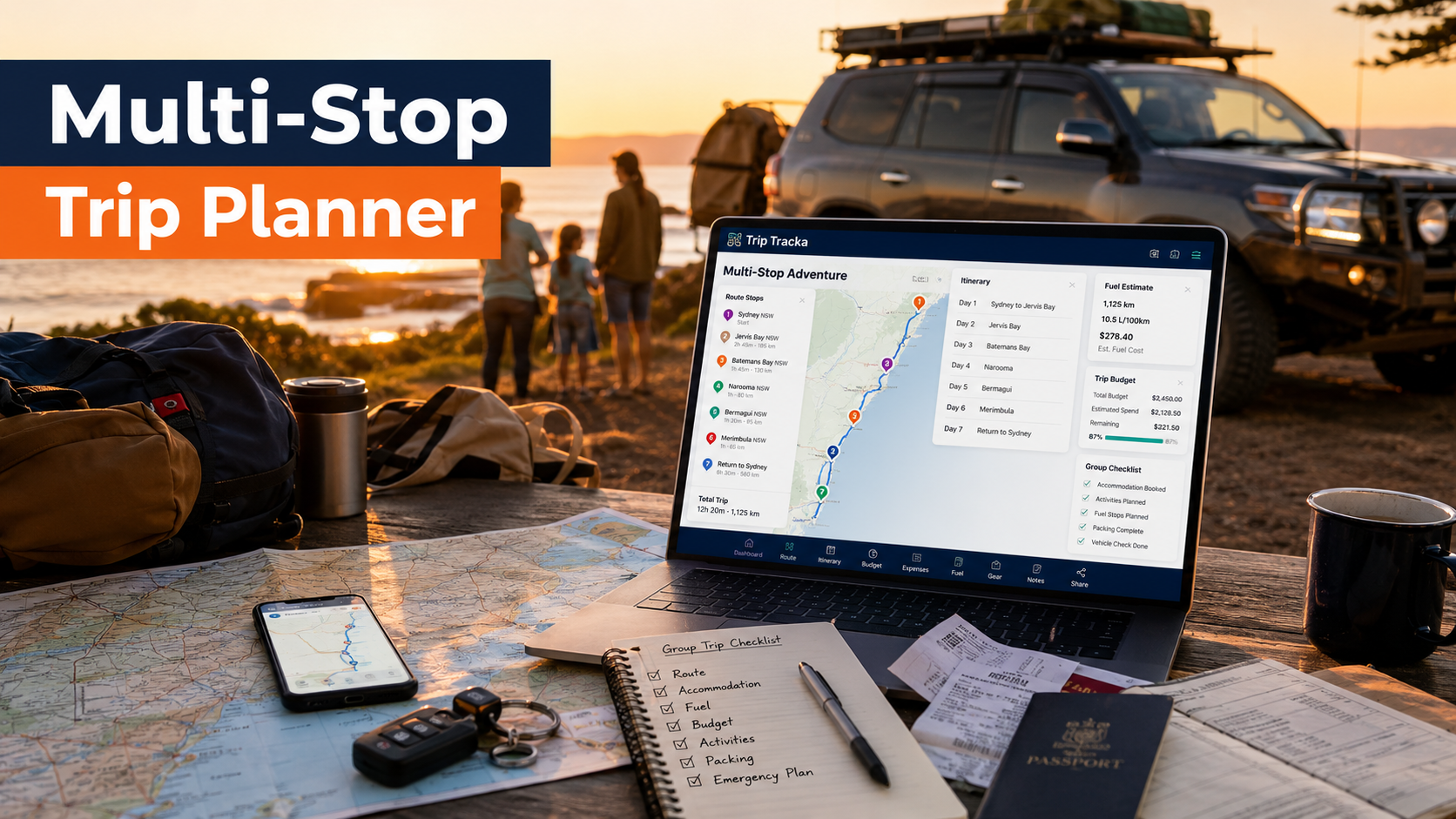
How to Plan a Multi-Stop Trip Without Making It Complicated
Planning a trip sounds fun at the start.
You pick a destination.
You save a few places.
You tell the family or group, “This will be easy.”
Then the details start piling up.
Where are we stopping first?
How far is each drive?
Who booked accommodation?
What is the fuel going to cost?
Are we doing free camps or hotels?
Who is paying for what?
Where did that screenshot go?
Which place did someone recommend in the group chat?
What happens if the kids need shorter driving days?
What happens if the group wants different things?
That is why multi-stop trip planning needs more than a basic map.
A good multi-stop trip plan connects your route, stops, accommodation, budget, fuel costs, activities, travel notes, gear and group decisions in one place.
That is where Trip Tracka helps. Trip Tracka gives travellers a way to plan routes, build budgets, track expenses, log fuel, organise gear and share trip details without relying on messy notes, screenshots and spreadsheets.
This guide will show you how to plan a multi-stop trip, what to look for in the best travel planner for families and how to use a group trip planning checklist so everyone knows what is happening before the trip begins.
What Is a Multi-Stop Trip?
A multi-stop trip is any trip with more than one major stop along the way.
It could be:
- A family road trip with overnight stops
- A caravan or RV trip with campsites and fuel stops
- A backpacking trip through multiple cities or countries
- A camping trip with several national parks
- A group holiday with friends
- A long weekend with scenic stops
- A Big Lap-style road trip
- A campervan trip through different towns
- A multi-country overseas holiday
The difference between a simple trip and a multi-stop trip is that each stop affects the next one.
If you drive too far on day one, everyone may be tired on day two.
If you forget to budget for one expensive activity, the whole trip budget can change.
If one person books the wrong night, the route can fall apart.
If the group does not agree on the plan, the trip can become stressful before it starts.
A proper Travel Planner helps keep the moving parts together.
Why Multi-Stop Trip Planning Gets Messy
Most trips do not become stressful because people forgot the destination.
They become stressful because the details are scattered everywhere.
The route is in one app.
The budget is in a spreadsheet.
Fuel estimates are guessed.
Accommodation is in email confirmations.
Activity ideas are in screenshots.
Group decisions are buried in messages.
Gear lists are in someone’s notes.
Receipts are in different wallets.
Everyone remembers a different version of the plan.
That might work for a one-night getaway.
It does not work well for a family road trip, a group holiday, a caravan trip, a campervan journey or a long-distance travel route.
A good Road Trip Planner or Route Planner should help you organise the route, save stops, record distances, estimate fuel, build a budget and keep travel notes connected to the trip.
How to Plan a Multi-Stop Trip Step by Step
A multi-stop trip becomes much easier when you plan it in the right order.
Do not start by booking random accommodation or saving every place you see online.
Start with the structure.
Step 1: Decide the Type of Trip
Before you plan the route, decide what kind of trip you are actually taking.
Ask:
- Is this a fast trip or a slow trip?
- Are we travelling as a family, couple, solo traveller or group?
- Are we driving, flying, backpacking, camping, caravanning or using public transport?
- Do we want hotels, motels, hostels, campgrounds, free camps or a mix?
- Are we trying to save money or enjoy more paid experiences?
- Do we need short driving days?
- Are we travelling with kids, pets, older family members or multiple vehicles?
- Do we want adventure, comfort, sightseeing, relaxation or a bit of everything?
This matters because a family trip with young kids needs a different plan from a group of backpackers. A caravan trip needs a different plan from a city-to-city holiday. A motorhome trip needs a different plan from a hotel-based road trip.
Trip Tracka works for different travel styles because you can plan routes, track fuel, build budgets and record expenses for road trips, camping, caravan travel, backpacking, family holidays and group travel.
Step 2: Choose Your Start, End and Must-See Stops
Every multi-stop trip needs three things:
- A starting point
- An end point
- The stops you do not want to miss
Do not overload the first version of the plan.
Start with the must-see places only.
For example:
Start: Melbourne
End: Adelaide
Must-see stops: Great Ocean Road, Mount Gambier, Robe, Victor Harbor
Once the main shape is clear, you can add smaller stops, lookouts, food stops, fuel stops, campsites and rest days.
A Route Planner is useful because you can save locations, organise waypoints and keep notes connected to the route instead of trying to remember everything from screenshots.
Step 3: Map the Route Before Booking Anything
One of the biggest mistakes travellers make is booking accommodation before checking if the route actually makes sense.
A town might look close on the map, but the real drive could be longer than expected because of traffic, roads, ferry crossings, mountains, border crossings or slow travel days.
Before booking, check:
- Distance between each stop
- Drive time between stops
- Fuel availability
- Accommodation options
- Check-in times
- Road conditions
- Rest stops
- Food stops
- Activities along the way
- Whether the route suits everyone travelling
If you are driving, use a Road Trip Planner to build the route and check the journey stop by stop.
For trips with more flexible routing, use the Travel Planner to bring routes, budgets, expenses and trip notes together.
Step 4: Keep Driving Days Realistic
This is one of the most important family travel planning tips.
Do not plan every day around the maximum distance you can drive.
Plan around what people can actually enjoy.
For families, shorter drive days are usually better. Kids need food stops, toilet breaks, playgrounds, beach time and slower mornings. Parents need time to set up, unpack, cook, shop and reset.
For group trips, people may have different travel speeds. Some may want early starts. Others may want coffee, slow mornings and photo stops.
For caravan, RV and motorhome travellers, long driving days can be more tiring because the setup is heavier and fuel stops take more planning.
A realistic multi-stop trip should include:
- Shorter drive days
- Rest days
- Buffer time
- Flexible arrival windows
- Backup stops
- Time for groceries, laundry and fuel
- Time to actually enjoy the destination
A trip that looks efficient on paper can feel exhausting on the road.
Step 5: Build a Day-by-Day Itinerary
Once your route makes sense, turn it into a day-by-day itinerary.
This helps everyone understand what is happening.
Example:
| Day | Stop | Main Plan | Notes |
|---|---|---|---|
| Day 1 | Home to first stop | Easy drive and setup | Keep this short |
| Day 2 | Coastal town | Beach, groceries, short walk | Low-cost day |
| Day 3 | National park | Lookouts and family walk | Check entry fees |
| Day 4 | Rest day | Laundry, food shop, relax | No big drive |
| Day 5 | Scenic drive | Photo stops and next stay | Fuel before leaving |
| Day 6 | Final destination | Activities and dinner | Book ahead |
This is much better than a loose list of places.
A proper itinerary helps you see whether the trip is too rushed, too expensive or missing important practical stops.
The AI Trip Planner can help create a first version of a day-by-day plan from a simple request, then you can adjust it to suit your travel style.
Step 6: Estimate Fuel and Transport Costs
Fuel is one of the biggest costs for road trips, caravans, campervans, RVs and motorhomes.
For kilometres, use this formula:
Distance ÷ 100 × litres per 100km × fuel price = estimated fuel cost
Example:
2,000km ÷ 100 × 12L/100km × $2.10 = $504
For miles, use this formula:
Distance ÷ MPG × fuel price per gallon = estimated fuel cost
But do not stop at the perfect estimate.
Add extra distance for:
- Detours
- Food stops
- Fuel stops
- Lookouts
- Wrong turns
- Campsites
- Supermarket runs
- Route changes
- Scenic drives
Then add a fuel buffer.
A good starting point is 10% to 20%, especially if you are towing, driving remotely or travelling somewhere fuel prices can change quickly.
Trip Tracka’s Fuel Tracker helps you track real fuel usage, fuel price, odometer readings and cost per kilometre as you travel.
Step 7: Create a Trip Budget
A multi-stop trip should always have a budget before you leave.
The best trip budgets are split by category.
Include:
- Fuel or transport
- Accommodation
- Groceries
- Eating out
- Activities
- Parking
- Tolls
- Ferries
- Laundry
- Internet
- Gear
- Insurance
- Emergency buffer
A simple trip budget might look like this:
| Category | Budget |
| Fuel / Transport | $800 |
| Accommodation | $1,200 |
| Groceries | $700 |
| Eating Out | $400 |
| Activities | $600 |
| Parking / Tolls / Ferries | $150 |
| Gear / Supplies | $250 |
| Laundry / Daily Costs | $150 |
| Emergency Buffer | $600 |
| Total | $4,850 |
Then work out your daily budget:
Total trip budget ÷ number of travel days = daily budget
Example:
$4,850 ÷ 21 days = $231 per day
The Trip Budget Planner helps you plan travel costs by category before you leave, then compare your budget with your real spending as the trip happens.
Step 8: Track Real Expenses During the Trip
A budget is only useful if you track the real numbers.
During the trip, track:
- Fuel
- Accommodation
- Food
- Activities
- Repairs
- Transport
- Parking
- Tolls
- Gear
- Emergency costs
This matters even more for group trips because people often pay for different things.
One person books accommodation.
Someone else pays for groceries.
Another person pays for fuel.
Someone covers an activity.
Then nobody knows what has actually been spent.
A Travel Expense Tracker helps keep real costs organised by category, trip and travel style.
For families, this helps stop overspending.
For groups, this helps reduce confusion.
For long-term travellers, this helps you understand your true daily burn rate.
Step 9: Build a Group Trip Planning Checklist
Group trips can be amazing, but they can also become messy if nobody knows who is doing what.
Use this group trip planning checklist before you leave.
Group Trip Planning Checklist
| Task | Who Is Responsible? | Done |
| Confirm travel dates | ||
| Choose start and end locations | ||
| Agree on must-see stops | ||
| Build the route | ||
| Confirm daily driving limits | ||
| Set the trip budget | ||
| Decide accommodation style | ||
| Book key accommodation | ||
| Estimate fuel or transport costs | ||
| Plan food and grocery costs | ||
| Choose paid activities | ||
| Create packing list | ||
| Confirm vehicles and drivers | ||
| Share emergency contacts | ||
| Track shared expenses | ||
| Save booking details | ||
| Confirm meeting points | ||
| Agree on backup plan |
The biggest thing with group travel is communication.
Everyone should know:
- Where you are going
- When you are leaving
- How much the trip may cost
- Who is booking what
- Who is driving
- What has already been paid
- What still needs to be decided
The Travel Planner helps because routes, budgets, expenses and trip details can stay connected instead of being split across multiple group chats.
Step 10: Build a Family Trip Planning Checklist
Family travel has extra details that solo travellers and couples may not need to think about.
Use this family trip planning checklist before your next holiday.
Family Trip Planning Checklist
| Category | What to Plan |
| Route | Shorter drive days, rest stops, realistic arrival times |
| Accommodation | Family rooms, laundry, kitchen, parking, safe location |
| Food | Groceries, snacks, easy meals, eating out budget |
| Activities | Playgrounds, beaches, walks, kid-friendly attractions |
| Safety | First aid, medications, emergency contacts |
| Gear | Prams, carriers, tablets, chargers, clothes, wet weather gear |
| Budget | Fuel, stays, food, activities, emergency buffer |
| Flexibility | Rest days, backup plans, weather options |
The best travel planner for families is not just the one that maps a route.
It should help with:
- Stops
- Budgets
- Expenses
- Fuel
- Accommodation notes
- Activities
- Gear
- Realistic travel days
- Shared planning
Trip Tracka is useful for families because it brings the route, budget, fuel and expenses into one place rather than making parents manage everything across five different apps.
What Makes the Best Travel Planner for Families?
The best travel planner for families should make the trip easier before and during travel.
Look for a planner that helps with:
- Multi-stop routes
- Saved places
- Day-by-day planning
- Family-friendly stops
- Fuel estimates
- Travel budgets
- Expense tracking
- Gear records
- Notes
- Shared access
- Flexible changes
- Past trip history
Families need more than directions.
They need a system.
A family trip involves food, snacks, laundry, fuel, activities, accommodation, gear, school holiday timing, tired kids and unexpected changes.
The Travel Planner is designed for routes, budgets, expenses, fuel and gear records in one platform, which makes it a better fit for real family travel than a basic map alone.
How AI Can Help With Multi-Stop Trip Planning
AI can help you start faster.
Instead of staring at a blank plan, you can ask for a trip idea.
Example prompt:
Plan a 12-day family road trip from Melbourne to the Gold Coast with two kids. Keep driving days realistic, include beaches, playgrounds, family activities, budget accommodation and rest days. Estimate fuel, food, accommodation and activity costs.
A good AI trip planner can help suggest:
- Route ideas
- Main stops
- Day-by-day structure
- Driving distances
- Fuel estimates
- Budget categories
- Rest days
- Activities
- Family-friendly stops
- Group planning ideas
Trip Tracka’s AI Trip Planner helps turn a rough idea into a clearer travel plan with route ideas, stops, waypoints and travel cost estimates.
AI is a strong starting point, but the real value comes from saving the plan, adjusting it and tracking the trip as it happens.
Multi-Stop Trip Example
Here is a simple example for a 10-day family road trip.
| Day | Stop | Plan | Budget Notes |
| Day 1 | Home to coastal town | Short drive, beach walk | Fuel + groceries |
| Day 2 | Coastal town | Rest day, playground, dinner out | Low fuel day |
| Day 3 | National park | Walks and lookout | Park entry + snacks |
| Day 4 | Inland town | Scenic drive and overnight stay | Fuel + accommodation |
| Day 5 | Lake stop | Swim, picnic, free activity | Grocery meal |
| Day 6 | City stop | Museum or attraction | Activity budget |
| Day 7 | Rest day | Laundry and food shop | Lower cost day |
| Day 8 | Mountain town | Scenic drive | Extra fuel |
| Day 9 | Final stop | Main attraction | Higher activity spend |
| Day 10 | Home | Drive home | Fuel only |
This kind of structure helps you avoid overloading the trip.
It also makes it easier to see where expensive days are and where cheaper days can balance the budget.
You can build this kind of plan inside the Road Trip Planner, then use the Trip Budget Planner and Travel Expense Tracker to manage the money side.
Packing and Gear for Multi-Stop Trips
Packing for a multi-stop trip is different from packing for one destination.
You may need gear for:
- Different weather
- Multiple accommodation types
- Camping or cooking
- Long drive days
- Kids
- Beach stops
- Hiking
- Emergencies
- Laundry
- Remote areas
- Work or school on the road
A gear list helps you avoid buying the same things twice or forgetting something important.
Use a Travel Gear Inventory to keep track of gear, receipts, warranty dates and packing lists.
This is useful for families, backpackers, campers, caravan travellers and group trips because everyone can see what they already have and what still needs to be packed.
Common Multi-Stop Trip Planning Mistakes
Planning Too Many Stops
More stops does not always mean a better trip.
Too many stops can make the trip feel rushed, especially with kids or a group.
Leave room to enjoy the places you visit.
Ignoring Travel Time Between Stops
A two-hour drive on a map can easily become four hours with fuel, food, toilets, traffic and photo stops.
Always add time buffers.
Forgetting the Budget
A route is not a full trip plan.
You also need to know what the trip may cost.
Use the Trip Budget Planner before you leave so fuel, accommodation, food and activities are not a surprise.
Not Tracking Expenses
If you do not track expenses during the trip, you may not realise you are overspending until it is too late.
Use the Travel Expense Tracker to record costs as they happen.
Relying Only on Group Chats
Group chats are good for conversation, but they are not a proper trip plan.
Important details get buried.
Keep the actual route, budget, stops and notes in one place.
Forgetting Rest Days
Rest days are not wasted days.
They help with laundry, groceries, recovery, weather changes and keeping the trip enjoyable.
Best Trip Tracka Tools for Multi-Stop Trip Planning
Trip Tracka brings the main parts of travel planning together so you do not need a messy mix of maps, notes, spreadsheets and screenshots.
Start with the Travel Planner to organise routes, budgets, expenses, fuel and gear records in one place.
Use the AI Trip Planner to generate route ideas, stops, waypoints and travel cost estimates from a simple trip idea.
Plan multi-stop drives with the Road Trip Planner, especially for family road trips, campervan journeys, caravans, RV travel and long-distance drives.
Map locations and save waypoints with the Route Planner.
Build your planned travel budget with the Trip Budget Planner.
Track real spending with the Travel Expense Tracker.
Monitor real fuel usage with the Fuel Tracker.
Organise packing lists, receipts and warranties with the Travel Gear Inventory.
For camping trips, use the Camping Trip Planner.
For backpacking trips, use the Backpacking Trip Planner.
Related Trip Tracka Guides
Want to keep planning smarter? These Trip Tracka guides can help.
Read How to Plan a Road Trip That Actually Works if you want a step-by-step road trip planning guide.
Read AI Trip Planner: Plan Your Road Trip, Budget, Fuel & Itinerary if you want to use AI to create routes, stops, budgets and itineraries faster.
Final Multi-Stop Trip Planning Checklist
Before you leave, make sure you have:
- Start and end locations
- Must-see stops
- Route mapped
- Accommodation plan
- Fuel estimate
- Trip budget
- Daily spending target
- Activity list
- Food and grocery plan
- Gear checklist
- Group responsibilities
- Shared expense plan
- Backup stops
- Rest days
- Emergency buffer
- Travel notes saved
- Real expense tracking ready
A good multi-stop trip does not need to be complicated.
It needs to be organised.
When your route, budget, expenses, fuel, gear and travel notes are connected, the trip becomes easier to enjoy.
That is exactly what Trip Tracka is built for.
FAQs
How do I plan a multi-stop trip?
Start by choosing your start point, end point and must-see stops. Then map the route, check driving distances, build a day-by-day itinerary, estimate fuel, create a budget and track real expenses as you travel. A tool like the Trip Tracka Travel Planner helps keep the route, budget and trip details organised.
What is the best travel planner for families?
The best travel planner for families should include routes, saved stops, realistic driving days, budgets, expenses, fuel tracking, gear lists and shared planning. Trip Tracka helps families plan trips, track costs and keep important travel details in one place.
What should be included in a group trip planning checklist?
A group trip planning checklist should include travel dates, route, stops, accommodation, budget, fuel costs, activities, packing list, drivers, shared expenses, emergency contacts, booking details and backup plans.
How do I plan a road trip with multiple stops?
Use a Road Trip Planner to add your start location, end location and mid-route stops. Check distance between each stop, estimate fuel, plan accommodation and build a realistic day-by-day schedule.
Can AI help plan a multi-stop trip?
Yes. An AI Trip Planner can help generate route ideas, suggested stops, day-by-day itineraries, budget categories and fuel estimates from a simple trip request. You should still review the plan and adjust it to suit your travel style.
How do I budget for a multi-stop trip?
List your main cost categories, including fuel, accommodation, food, activities, parking, tolls, transport, gear and emergency money. Then divide the total by the number of travel days to get a daily budget. Use the Trip Budget Planner to track planned costs and compare them with real spending.
How do I track expenses on a group trip?
Use a Travel Expense Tracker to record fuel, accommodation, food, activities and shared costs as they happen. This helps reduce confusion and keeps the group clear on what has been spent.
What is the easiest way to organise trip gear?
Use a Travel Gear Inventory to save gear details, receipts, purchase dates, warranty information and packing lists. This is useful for families, campers, backpackers, caravanners and group travellers.
Is Trip Tracka only for road trips?
No. Trip Tracka can be used for road trips, family holidays, camping trips, caravan travel, RV travel, backpacking, group trips, overseas travel and long-term travel planning.
Comments
Be the first to comment.