
Why Travellers Should Record Gear Purchases | Travel Gear Inventory Checklist
Why Travellers Should Record Gear Purchases
Travel gear is one of the easiest things to spend money on and one of the easiest things to forget about.
A backpack here.
A camp chair there.
New hiking shoes.
A fridge.
A power bank.
A camera.
A roof rack.
A tent.
A sleeping bag.
A portable stove.
A solar panel.
A replacement charger.
Another storage box.
More recovery gear.
More travel accessories.
At the time, each purchase makes sense.
But months later, most travellers cannot remember what they bought, when they bought it, how much it cost, where the receipt is or whether it is still under warranty.
That is why travellers should record gear purchases properly.
A travel gear inventory is not just a list of things you own. It can help with warranty claims, insurance records, packing, budgeting, replacements, trip planning and understanding how much your travel setup is actually worth.
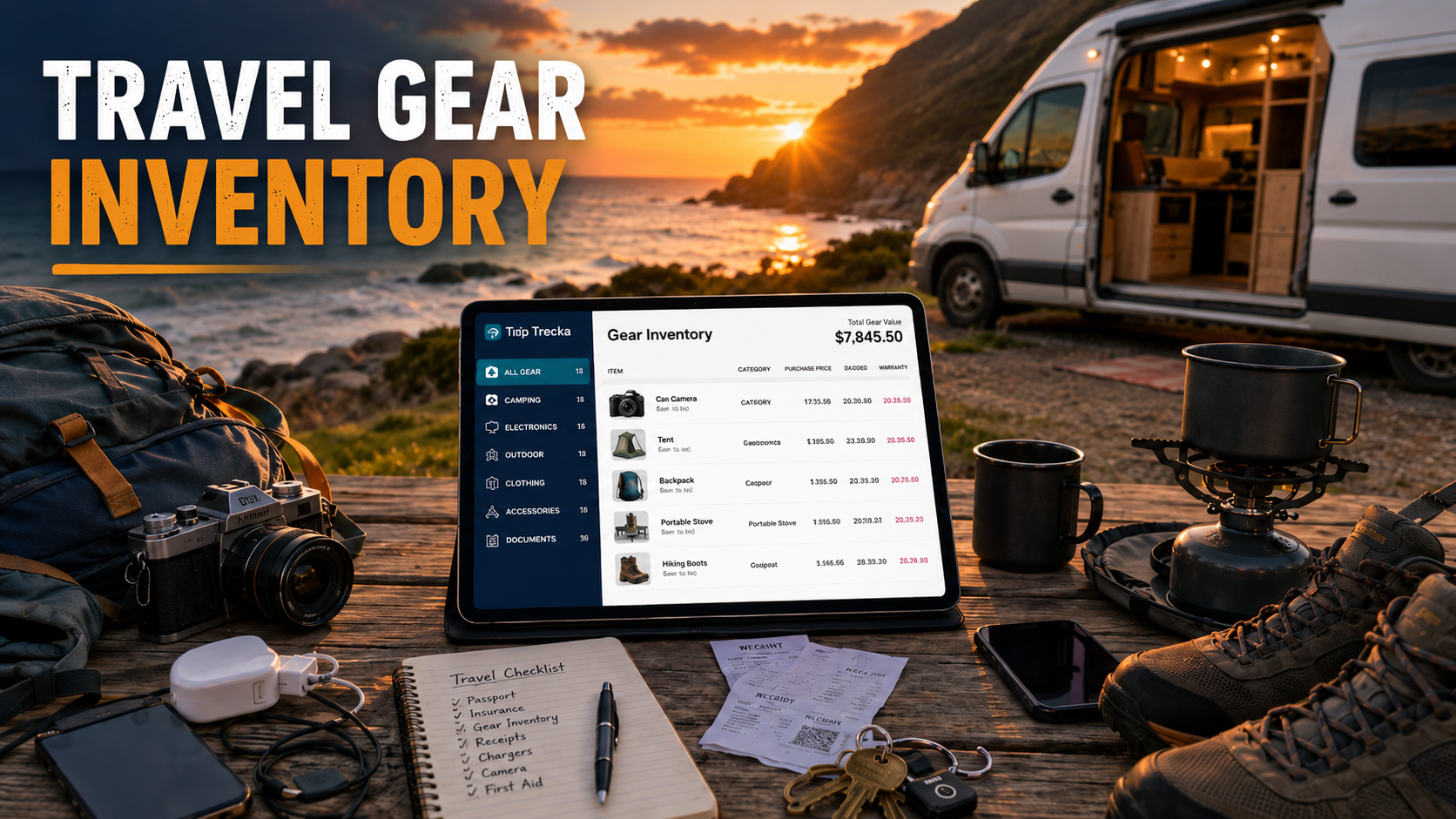
With Trip Tracka’s Travel Gear Inventory, travellers can keep gear records, purchase prices, receipts, warranty dates and important item details organised in one place.
This guide will show you why travel gear records matter, what to include in a travel gear inventory checklist and how to store receipts so your gear information is easy to find when you need it.
Why Gear Records Matter for Travellers
Most people only realise they needed gear records when something goes wrong.
A fridge stops working.
A tent pole breaks.
A camera is damaged.
A charger fails.
A bag is stolen.
A camp stove needs a warranty claim.
A caravan accessory needs replacing.
A backpacking item gets lost.
A receipt is needed for insurance.
That is when the questions start.
When did I buy it?
Where did I buy it?
How much did it cost?
Was it still under warranty?
Do I have the receipt?
Did I take a photo of it?
Was the serial number saved anywhere?
Could I prove I owned it?
A proper gear record can answer those questions quickly.
Instead of digging through emails, glove boxes, drawers, camera rolls and old bank statements, you can keep the important details together.
Trip Tracka is useful because the Travel Gear Inventory connects gear records with the rest of your travel planning, including budgets, expenses and trip organisation.
What Is a Travel Gear Inventory?
A travel gear inventory is a record of the gear, equipment and important travel items you own or carry.
It can include:
- Item name
- Category
- Purchase date
- Purchase price
- Receipt
- Warranty end date
- Serial number
- Model number
- Store or seller
- Item photo
- Notes
- Replacement cost
- Condition
- Trip it belongs to
- Where it is stored
- Whether it is packed
- Whether it needs replacing
This can be useful for any type of traveller.
A backpacker might record a backpack, camera, laptop, hiking shoes and power bank.
A family might record suitcases, tablets, chargers, car seats, camp gear and travel accessories.
A camper might record tents, sleeping bags, lights, cooking gear and camp furniture.
A caravanner might record caravan gear, solar equipment, hoses, leads, tools, fridge gear, recovery gear and spare parts.
A digital nomad might record laptops, cameras, hard drives, microphones, chargers, adapters and insurance items.
A Travel Planner helps organise the trip, while a travel gear inventory helps organise the things you rely on during the trip.
Why Travellers Should Record Gear Purchases
There are several practical reasons to keep proper gear records.
1. Warranty Claims Are Easier
Warranty claims usually need proof.
You may need:
- Receipt
- Purchase date
- Store name
- Item model
- Serial number
- Photo of the item
- Description of the issue
Without this information, a warranty claim can become frustrating.
You might know the item should still be covered, but if you cannot prove when and where you bought it, the claim may be harder.
This matters for travel gear like:
- Fridges
- Solar panels
- Power stations
- Batteries
- Tents
- Sleeping gear
- Cameras
- Laptops
- Phones
- GPS devices
- Camp stoves
- Recovery gear
- Portable appliances
- Caravan accessories
Recording your gear purchases as soon as you buy them makes warranty claims much easier later.
The Travel Gear Inventory helps you store purchase prices, receipts and warranty dates so you are not relying on memory.
2. Insurance Claims Need Proof of Ownership
Insurance is another major reason to record gear purchases.
If gear is stolen, damaged or lost, you may need to prove what you owned and what it was worth.
A clear gear record can help show:
- Item name
- Purchase date
- Purchase value
- Receipt
- Photo
- Serial number
- Replacement estimate
This is useful for travel insurance, vehicle insurance, caravan insurance, campervan insurance, home contents insurance and personal item cover.
Even if you never need to claim, having the records gives you peace of mind.
For families, caravanners, campers, backpackers and long-term travellers, the total value of gear can be much higher than expected.
A travel gear inventory helps you understand that value before something goes wrong.
3. You Know What Your Travel Setup Is Worth
Travel gear adds up quickly.
A few small purchases can become thousands of dollars over time.
Example:
| Gear Item | Estimated Value |
|---|---|
| Backpack or luggage | $250 |
| Hiking shoes | $220 |
| Camera | $900 |
| Laptop | $1,800 |
| Power bank | $150 |
| Camp stove | $180 |
| Tent | $700 |
| Sleeping bags | $400 |
| Camp chairs | $180 |
| Portable fridge | $1,200 |
| Solar panel | $350 |
| Recovery gear | $500 |
| Travel accessories | $300 |
| Total | $7,130 |
Most travellers do not think about the full value because the gear was bought over time.
A gear inventory helps you see what you own, what it cost and what may need protecting.
This can also help when creating a Trip Budget Planner, because gear costs are part of the real cost of travel.
4. Packing Becomes Easier
Packing is easier when your gear is already organised.
Instead of building a new packing list from scratch every trip, you can use your gear inventory to check what you already own.
This helps avoid:
- Forgetting important gear
- Buying the same item twice
- Taking gear you do not need
- Leaving expensive items behind
- Packing too much
- Forgetting chargers, cables or accessories
- Missing weather-specific items
- Forgetting warranty or safety gear
This is especially useful for:
- Family trips
- Camping trips
- Caravan trips
- Backpacking trips
- Overseas travel
- Long-term travel
- Digital nomad travel
- Group travel
If you are planning a camping trip, use the Camping Trip Planner with your travel gear inventory so your route, campsites, budget and gear are easier to organise.
5. You Can Plan Replacements Before They Become Problems
Some gear has a life span.
Hiking shoes wear out.
Batteries lose performance.
Solar gear may need upgrading.
Camp chairs break.
Fridges need servicing.
Sleeping gear wears down.
Backpacks get damaged.
Cables fail.
Tents lose waterproofing.
If you record purchase dates and notes, you can see what might need replacing before the next big trip.
This helps you avoid last-minute spending.
Instead of buying replacement gear in a rush, you can plan it into your travel budget.
Use the Trip Budget Planner to include gear replacements before you leave, then track the real purchase cost with the Travel Expense Tracker.
6. Travel Expenses Become More Accurate
Travel costs are not only fuel, accommodation and food.
Gear is part of the real cost of travel.
If you buy a new tent for a camping trip, that is a trip cost.
If you buy a new backpack before an overseas trip, that is a travel cost.
If you replace a charger, battery or storage box during the trip, that is a travel cost.
A Travel Expense Tracker helps you record gear purchases alongside fuel, accommodation, food, activities and daily spending.
This gives you a more honest picture of what the trip actually cost.
It also helps you plan better next time.
7. Group and Family Travel Is Easier to Organise
Families and groups often share gear.
One person brings the stove.
Someone else brings the tent.
Another person brings camp chairs.
One family brings the first aid kit.
Someone brings spare chargers.
Another person brings cooking gear.
Without a proper list, people double up on some things and forget others.
A gear inventory helps answer:
- Who owns what?
- What is already packed?
- What still needs buying?
- What gear needs replacing?
- What receipts should be saved?
- What items are expensive enough to insure?
- What should be checked before the trip?
This is useful for group road trips, family holidays, camping trips, caravan travel and long-term travel.
Trip Tracka also supports trip planning, budgeting and expense tracking, so gear records can sit alongside the rest of the travel plan.
Travel Gear Inventory Checklist
Use this travel gear inventory checklist to organise your records.
Main Gear Details
| Detail | Why It Matters |
| Item name | Helps identify the gear quickly |
| Category | Keeps gear organised |
| Purchase date | Useful for warranty and replacement planning |
| Purchase price | Helps with budgeting and insurance |
| Receipt | Proof of purchase |
| Warranty end date | Helps you claim before warranty expires |
| Store or seller | Useful for returns and warranty support |
| Brand / model | Helps identify the exact item |
| Serial number | Important for electronics and expensive gear |
| Item photo | Helps prove ownership and condition |
| Notes | Useful for storage, condition or repairs |
| Replacement cost | Helpful for insurance and budgeting |
| Packed status | Useful before a trip |
Travel Gear Categories to Track
Your travel gear inventory should be organised by category.
Use categories like:
- Bags and luggage
- Backpacking gear
- Camping gear
- Caravan gear
- Campervan gear
- RV gear
- Cooking gear
- Electronics
- Cameras and content gear
- Clothing
- Footwear
- Safety gear
- Recovery gear
- First aid
- Kids’ travel gear
- Pet travel gear
- Tools
- Spare parts
- Navigation gear
- Power and charging
- Internet and work gear
- Documents and travel accessories
The more organised your categories are, the easier it is to find what you need.
Camping Gear Inventory Checklist
For camping trips, record items like:
- Tent
- Swags
- Sleeping bags
- Sleeping mats
- Pillows
- Camp chairs
- Camp table
- Stove
- Gas bottle
- Cookware
- Plates and cutlery
- Fridge or cooler
- Lighting
- Solar panel
- Power station
- Water containers
- First aid kit
- Fire safety gear
- Tarps
- Ropes
- Pegs
- Tools
- Storage tubs
A Camping Trip Planner can help connect your campsites, route, gear and budget before you leave.
Caravan and RV Gear Inventory Checklist
For caravan, campervan and RV travel, record items like:
- Hoses
- Leads
- Levelling ramps
- Wheel chocks
- Tow mirrors
- Extension cords
- Water filters
- Gas fittings
- Awning gear
- Solar equipment
- Batteries
- Portable fridge
- Spare parts
- Tools
- Recovery gear
- Outdoor mats
- Camp furniture
- Cooking gear
- Safety gear
- Fire extinguisher
- First aid kit
- Tyre gear
- Bearings and service parts
For caravan trips, use the Caravan Trip Planner to keep routes, camps, fuel and travel costs organised.
For campervan trips, use the Campervan Trip Planner to plan overnight stops, fuel, budgets and van gear records.
Backpacking Gear Inventory Checklist
For backpackers, record items like:
- Backpack
- Daypack
- Packing cubes
- Travel wallet
- Passport holder
- Power bank
- Universal adapter
- Phone charger
- Laptop or tablet
- Camera
- Headphones
- Hiking shoes
- Rain jacket
- Travel towel
- First aid kit
- Toiletry bag
- Locks
- Water bottle
- Lightweight clothing
- Travel documents
- Copies of receipts
- Insurance details
Backpackers often travel through multiple countries, so gear records can help with insurance, replacements and budgeting.
Family Travel Gear Checklist
For families, record items like:
- Suitcases
- Kids’ backpacks
- Tablets
- Chargers
- Headphones
- Car seats
- Prams
- Baby carriers
- Travel cots
- Snacks storage
- First aid supplies
- Medication
- Wet weather gear
- Beach gear
- School or activity items
- Camping equipment
- Kids’ sleeping gear
- Family electronics
Family travel usually involves more gear than expected.
A clear inventory helps reduce stress before leaving home.
Digital Nomad Gear Checklist
For digital nomads and remote workers, record items like:
- Laptop
- Tablet
- Phone
- Camera
- Microphone
- Hard drives
- Cloud backup tools
- Chargers
- Cables
- Power banks
- Travel monitor
- Mouse and keyboard
- Headphones
- Tripod
- Internet devices
- Work bag
- Insurance items
- Receipts and serial numbers
This type of gear can be expensive, so records are important for insurance and replacement.
How to Store Receipts for Travel Gear
Receipts are one of the most important parts of a gear record.
A gear list without receipts is still helpful, but receipts make warranty and insurance claims much easier.
Here is how to store receipts properly.
Step 1: Save the Receipt Immediately
Do not wait until later.
As soon as you buy travel gear, save the receipt.
You can:
- Take a photo
- Save the email receipt
- Download the PDF invoice
- Screenshot the order confirmation
- Save the paper receipt digitally
- Add the receipt to your gear record
Waiting is how receipts get lost.
If you record the receipt straight away, you will not have to search for it months later.
Step 2: Match the Receipt to the Gear Item
A folder full of random receipts is better than nothing, but it can still be messy.
The best method is to connect the receipt to the actual gear item.
For each item, record:
- Item name
- Purchase date
- Purchase price
- Store
- Warranty date
- Receipt
- Notes
The Travel Gear Inventory helps keep this information organised around the gear itself, not just in a random folder.
Step 3: Store Both Digital and Paper Receipts When Needed
Paper receipts can fade, get wet or disappear.
Digital receipts are easier to keep.
For important gear, store:
- A photo of the paper receipt
- A PDF copy if available
- The email invoice
- A photo of the item
- Warranty details
- Serial number
For expensive gear, keep the paper receipt somewhere safe as a backup if needed.
Step 4: Record Warranty Dates
Do not only save the receipt.
Record the warranty date as well.
This helps you know when you need to act.
If an item is close to the end of warranty and has issues, you can deal with it before the warranty runs out.
Warranty dates are especially useful for:
- Electronics
- Fridges
- Solar panels
- Power stations
- Cameras
- Laptops
- Camping equipment
- Caravan accessories
- Travel appliances
- Navigation devices
Step 5: Take Photos of Expensive Items
Photos help prove ownership and condition.
For valuable gear, take photos of:
- The item
- Serial number
- Model number
- Accessories
- Any damage
- Receipt
- Original packaging, if useful
This can help with insurance, warranty and replacement claims.
Step 6: Keep Gear Records Updated During the Trip
Travel gear changes over time.
You may buy new gear, sell old gear, replace broken items or upgrade your setup.
Update your inventory when:
- You buy new gear
- You replace an item
- You sell gear
- Something breaks
- Warranty changes
- You find a missing receipt
- You add new accessories
- You remove gear from your setup
A travel gear inventory is most useful when it stays current.
Travel Gear Receipt Storage Checklist
Use this checklist for every important gear purchase.
| Receipt Detail | Saved |
| Receipt photo or PDF | |
| Purchase date | |
| Purchase price | |
| Store or seller | |
| Warranty period | |
| Warranty end date | |
| Item photo | |
| Serial number | |
| Model number | |
| Notes added | |
| Linked to gear item | |
| Replacement cost recorded |
How Gear Records Help With Travel Insurance
Insurance claims can be stressful if you do not have records.
Good gear records can help show:
- What you owned
- What it cost
- When you bought it
- Its condition
- Whether it was still under warranty
- Whether it was part of your travel setup
- Whether you had proof of ownership
For expensive items, record more detail.
Examples:
- Laptop
- Camera
- Drone
- Power station
- Portable fridge
- Solar setup
- Recovery gear
- Bike
- Surfboard
- Camping setup
- Caravan accessories
Even if your insurer asks for extra information, having clear records puts you in a stronger position than relying on memory.
How Gear Records Help With Budgeting
Gear purchases can make a trip more expensive than expected.
Many travellers build a budget for fuel, accommodation and food but forget gear.
Before a big trip, you might buy:
- New bags
- Shoes
- Clothes
- Chargers
- Camp gear
- Cooking gear
- First aid items
- Travel accessories
- Storage gear
- Spare parts
- Safety equipment
Those costs should be part of the trip budget.
Use the Trip Budget Planner to plan gear spending before you leave, then record the real purchase costs with the Travel Expense Tracker.
This gives you a much clearer view of the true cost of travel.
How Gear Records Help With Packing
A travel gear inventory is also a packing tool.
Before a trip, review your inventory and ask:
- What do we already own?
- What needs replacing?
- What is missing?
- What needs charging?
- What needs cleaning?
- What needs testing?
- What should stay home?
- What is expensive enough to insure?
- What receipts should be saved?
- What gear is trip-specific?
This is helpful for weekend trips, international travel, family holidays, camping, caravanning, backpacking and long-term travel.
If you are planning routes and budgets in the Travel Planner, gear records help complete the planning process.
Common Mistakes Travellers Make With Gear Records
Not Saving Receipts
This is the biggest mistake.
A receipt is easiest to save on the day you buy the item.
Do not wait.
Only Keeping Paper Receipts
Paper receipts can fade, tear, get wet or disappear.
Take a digital photo as backup.
Not Recording Warranty Dates
A receipt tells you when you bought the item.
A warranty date tells you when you need to act.
Record both.
Forgetting Serial Numbers
Serial numbers are important for electronics, cameras, laptops, power stations and expensive gear.
Save them early.
Not Updating the Inventory
A gear inventory is not a one-time job.
Update it when you buy, replace, sell or remove gear.
Not Tracking Gear Costs in the Trip Budget
Gear is part of travel spending.
If you buy gear for a trip, record it in your travel expenses.
Waiting Until Something Goes Wrong
Most people start looking for receipts after something breaks.
By then, it is often too late.
Create the record before you need it.
Best Trip Tracka Tools for Gear and Travel Records
Trip Tracka brings travel planning, budgeting, expenses and gear records together so your trip information is easier to manage.
Use the Travel Gear Inventory to keep records of your gear, purchase prices, receipts, warranty dates and important item details.
Use the Travel Planner to organise your routes, stops, budgets, expenses, fuel and gear records in one place.
Use the Trip Budget Planner to plan gear purchases as part of your total trip budget.
Use the Travel Expense Tracker to record real gear costs, replacement items and other travel spending.
Use the Fuel Tracker to track fuel costs beside gear, accommodation, food and other trip expenses.
Use the Camping Trip Planner to connect campsites, routes, budgets and camping gear.
Use the Caravan Trip Planner to organise caravan routes, towing fuel, travel costs and caravan gear.
Use the Campervan Trip Planner to plan overnight stops, budgets, fuel and campervan gear.
Use the AI Trip Planner to generate trip ideas, routes, cost estimates and planning structure, then organise the real gear and expense records inside Trip Tracka.
Final Travel Gear Inventory Checklist
Before your next trip, make sure you have recorded:
- Gear item name
- Category
- Purchase date
- Purchase price
- Receipt
- Warranty date
- Store or seller
- Brand or model
- Serial number
- Item photo
- Replacement value
- Notes
- Packed status
- Condition
- Trip relevance
- Insurance value
- Gear needing replacement
- Gear needing repair
- Missing receipts
A good travel gear inventory does not need to be complicated.
It just needs to be easy to update and easy to find when you need it.
When your gear records, receipts, warranties, budgets and expenses are organised, travel becomes less stressful.
That is what Trip Tracka is built for.
FAQs
Why should travellers record gear purchases?
Travellers should record gear purchases so they can keep proof of ownership, purchase dates, prices, receipts, warranty information and replacement values organised. This can help with warranty claims, insurance claims, packing, budgeting and trip planning.
What should I include in a travel gear inventory checklist?
A travel gear inventory checklist should include item name, category, purchase date, purchase price, receipt, warranty date, store, model, serial number, item photo, condition, notes and replacement value.
How should I store receipts for travel gear?
The best way to store receipts is to save a digital copy as soon as you buy the item. Take a photo of paper receipts, save email invoices and connect the receipt to the actual gear item inside a tool like the Travel Gear Inventory.
Why are receipts important for travel gear?
Receipts help prove when and where you bought an item, how much it cost and whether it may still be under warranty. They can also help with insurance claims if gear is stolen, lost or damaged.
What travel gear should I record?
Record expensive, important or frequently used gear, including backpacks, cameras, laptops, camping gear, caravan gear, campervan gear, electronics, power gear, hiking shoes, travel accessories, cooking gear, safety gear and recovery equipment.
Can a travel gear inventory help with insurance?
Yes. A gear inventory can help prove ownership, value, purchase date and item details if you need to make an insurance claim. Photos, receipts and serial numbers are especially useful.
Can Trip Tracka store travel gear receipts?
Yes. Trip Tracka’s Travel Gear Inventory helps travellers keep gear records, purchase prices, receipts, warranty dates and important item details organised.
Should gear purchases be included in my trip budget?
Yes. Gear purchases are part of the real cost of travel. Use the Trip Budget Planner to plan gear costs before the trip and the Travel Expense Tracker to record real purchases.
Is a travel gear inventory useful for backpackers?
Yes. Backpackers often carry valuable gear like backpacks, cameras, laptops, shoes, chargers and travel documents. Keeping receipts and purchase records organised can help with insurance, replacements and budgeting.
Is a travel gear inventory useful for caravans, camping and RV travel?
Yes. Caravan, camping and RV setups often include expensive gear like fridges, solar panels, batteries, tents, cooking gear, hoses, leads, tools and recovery equipment. A gear inventory helps keep these records organised.
Ready to stop losing receipts, guessing purchase dates and forgetting what your travel gear is worth?
Use Trip Tracka to record your gear purchases, store receipts, track warranty dates, plan your trip budget and keep your travel records organised in one place.
Create your free Trip Tracka account today and start organising your travel gear with confidence.
Comments
Be the first to comment.