
How to Calculate Fuel Cost for a Trip: Fuel Cost Per KM, Per Mile & RV Fuel Cost Calculator Guide
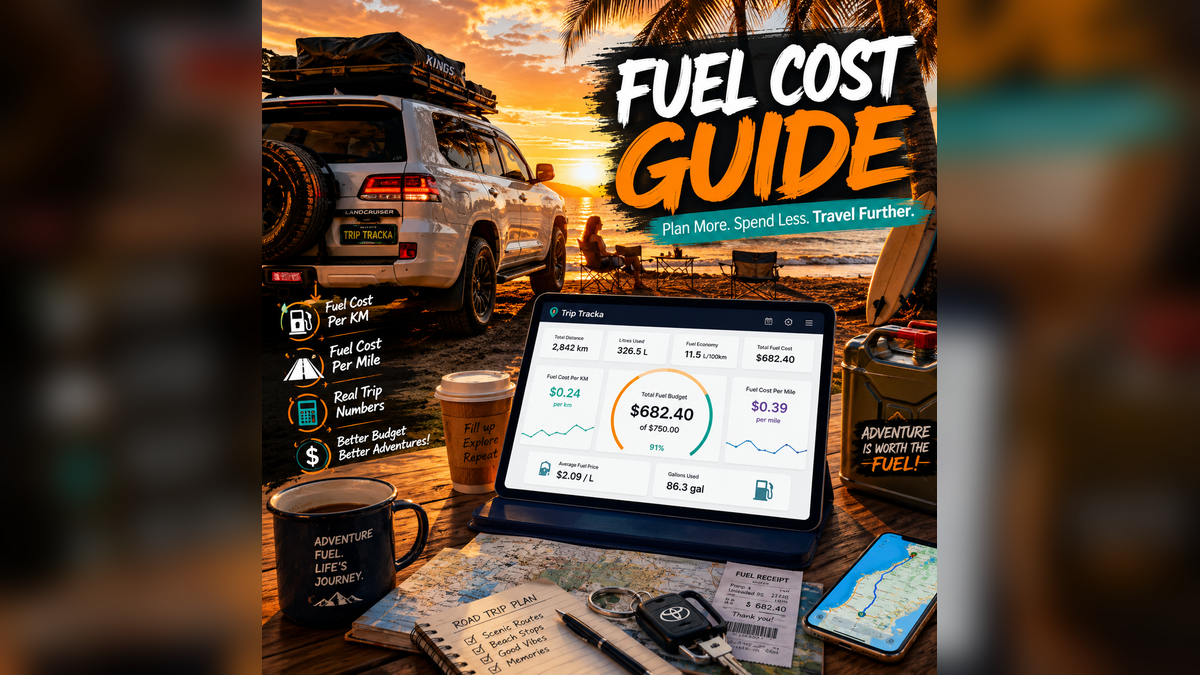
How to Calculate Fuel Cost for a Trip
Fuel is one of the biggest travel costs for road trippers, RV travellers, campervan owners, 4WD tourers, caravanners, motorhome travellers and families planning long-distance holidays.
But most people still plan fuel costs by guessing.
They check the map, look at the distance, guess the fuel price and hope the number is close.
The problem is that fuel costs can change quickly depending on distance, fuel price, vehicle weight, towing, road conditions, wind, tyre pressure, traffic, hills and how you drive.
That is why learning how to calculate fuel cost for a trip is one of the smartest things you can do before hitting the road.
Whether you are planning a weekend road trip, a cross-country adventure, a lap around Australia, a USA RV holiday, a Europe campervan trip, a UK road trip or a long-term travel journey, this guide will show you how to calculate your fuel cost per km, fuel cost per mile and total trip fuel budget.
You can also use Trip Tracka to plan your trip, track fuel usage, record travel expenses, manage budgets and keep your travel records in one place.
Why Fuel Costs Matter When Planning a Trip
Fuel is not just another travel expense.
It can control where you go, how far you travel and how much money you have left for accommodation, food, attractions and experiences.
A small car on a short highway trip may use very little fuel. But a loaded 4WD towing a caravan, an RV climbing through mountain roads or a campervan driving into headwinds can use far more fuel than expected.
A proper fuel cost guide should include:
- Total travel distance
- Vehicle fuel economy
- Current fuel price
- Towing weight
- Road conditions
- Extra distance for detours
- Fuel price buffer
- Actual fuel usage during the trip
A fuel estimate is helpful, but a live fuel tracker is better.
That is why the Trip Tracka Fuel Tracker is useful for travellers who want to track real fuel usage instead of relying on rough guesses.
Simple Fuel Cost Formula
The easiest way to calculate fuel cost is to use your distance, fuel economy and fuel price.
Fuel Cost Formula for Kilometres
Distance ÷ 100 × fuel usage per 100km × fuel price = total fuel cost
Example:
You are driving 2,500km.
Your vehicle uses 12L/100km.
Fuel costs $2.10 per litre.
2,500 ÷ 100 = 25
25 × 12 = 300 litres
300 × $2.10 = $630
Estimated fuel cost:
$630
Once you have calculated your estimated fuel cost, add it into your Trip Budget Planner so you can compare your planned fuel budget against your real spending while travelling.
Fuel Cost Formula for Miles
Distance ÷ MPG × fuel price per gallon = total fuel cost
Example:
You are driving 1,500 miles.
Your vehicle gets 20 MPG.
Fuel costs $4.00 per gallon.
1,500 ÷ 20 = 75 gallons
75 × $4.00 = $300
Estimated fuel cost:
$300
If you are planning a long-distance road trip, use a Route Planner to map out your stops, estimate distance and connect fuel costs to the trip you are actually planning.
How to Calculate Fuel Cost Per KM
Fuel cost per km shows how much your vehicle costs to drive for every kilometre.
This is useful because it gives you a real number you can use for future trip planning.
Fuel Cost Per KM Formula
Total fuel cost ÷ total kilometres driven = fuel cost per km
Example:
You spent $630 on fuel.
You drove 2,500km.
$630 ÷ 2,500 = $0.252 per km
Your fuel cost is:
25.2 cents per kilometre
This number is powerful because you can use it to estimate future trips.
For example, if your real fuel cost is $0.25 per km, then a 1,000km trip will likely cost around:
1,000 × $0.25 = $250
Using a Fuel Tracker makes this easier because you can record fuel refills, fuel price, distance travelled and real fuel economy as you go.
How to Calculate Fuel Cost Per Mile
Fuel cost per mile works the same way.
It shows how much your vehicle costs to drive for every mile.
Fuel Cost Per Mile Formula
Total fuel cost ÷ total miles driven = fuel cost per mile
Example:
You spent $300 on fuel.
You drove 1,500 miles.
$300 ÷ 1,500 = $0.20 per mile
Your fuel cost is:
20 cents per mile
If your next trip is 2,000 miles, your estimated fuel cost would be:
2,000 × $0.20 = $400
Whether you use kilometres or miles, tracking your real cost helps you build a better Travel Budget for future trips.
Why RV Fuel Costs Are Different
RV fuel costs are usually higher than a normal car because RVs, motorhomes, campervans and vehicles towing caravans are heavier and less aerodynamic.
An RV fuel cost calculator should consider:
- Vehicle size
- Total vehicle weight
- Towing weight
- Roof racks
- Bikes, boats or extra gear
- Road surface
- Mountain driving
- City driving
- Highway speed
- Headwinds
- Tyre pressure
- Fuel type
- Generator fuel use, if applicable
A large RV, motorhome or 4WD towing a caravan can use much more fuel than expected, especially on hilly roads or in windy conditions.
For road trips, RV travel, caravan trips and long-distance drives, a proper Road Trip Planner helps you think beyond the map and plan for the real cost of the trip.
RV Fuel Cost Calculator Example
Let’s say you are planning an RV trip.
Distance: 3,000km
Fuel usage: 22L/100km
Fuel price: $2.00 per litre
Formula:
3,000 ÷ 100 × 22 × $2.00
Step-by-step:
3,000 ÷ 100 = 30
30 × 22 = 660 litres
660 × $2.00 = $1,320
Estimated RV fuel cost:
$1,320
Now add a 10% buffer:
$1,320 × 10% = $132
Total fuel budget:
$1,452
This is much safer than budgeting only for the perfect-case fuel estimate.
You can add this estimate to your Trip Budget Planner, then record your real fuel spending through the Fuel Tracker during the trip.
Campervan Fuel Cost Calculator Example
A campervan may use less fuel than a large RV but more than a small car.
Distance: 1,800km
Fuel usage: 11L/100km
Fuel price: $1.95 per litre
Formula:
1,800 ÷ 100 × 11 × $1.95
Step-by-step:
1,800 ÷ 100 = 18
18 × 11 = 198 litres
198 × $1.95 = $386.10
Estimated campervan fuel cost:
$386.10
Add a 10% buffer:
$386.10 + $38.61 = $424.71
Suggested fuel budget:
$425
This gives you a more realistic fuel budget than guessing from the map distance alone.
4WD and Caravan Fuel Cost Example
Towing can dramatically increase fuel usage.
Distance: 2,200km
Fuel usage while towing: 19.5L/100km
Fuel price: $2.20 per litre
Formula:
2,200 ÷ 100 × 19.5 × $2.20
Step-by-step:
2,200 ÷ 100 = 22
22 × 19.5 = 429 litres
429 × $2.20 = $943.80
Estimated fuel cost:
$943.80
Add a 15% towing buffer:
$943.80 × 15% = $141.57
Suggested fuel budget:
$1,085.37
Rounded:
$1,100
If you are towing, your fuel budget should always be based on your towing fuel economy, not your normal everyday driving fuel economy.
For caravan travel, a Caravan Trip Planner can help you plan routes, camps, fuel and travel costs with towing in mind.
Travel Fuel Budget Table
| Trip Type | Distance | Fuel Usage | Fuel Price | Estimated Fuel Cost |
|---|---|---|---|---|
| Small car road trip | 1,000km | 7L/100km | $2.00/L | $140 |
| SUV road trip | 1,500km | 10L/100km | $2.00/L | $300 |
| Campervan trip | 1,800km | 11L/100km | $1.95/L | $386 |
| 4WD towing caravan | 2,200km | 19.5L/100km | $2.20/L | $944 |
| RV or motorhome | 3,000km | 22L/100km | $2.00/L | $1,320 |
These numbers are examples only. Your real cost will depend on your vehicle, fuel price, route and driving conditions.
To get a clearer view of your full travel cost, track fuel beside accommodation, food, activities, gear and daily costs inside a Travel Expense Tracker.
What Affects Fuel Cost on a Road Trip?
Fuel cost is not only about distance.
Several things can change your real fuel usage.
Towing
Caravans, trailers, boats and extra loads increase fuel usage.
Even if your vehicle normally uses 10L/100km, it may use 16L/100km, 20L/100km or more while towing.
Vehicle Weight
More weight means more fuel.
Extra water, tools, camping gear, food, spare parts, roof racks and storage boxes all add up.
You can use a Travel Gear Inventory to keep track of what you are carrying, what it cost and what important gear records you need to keep.
Speed
Driving faster usually uses more fuel.
Slowing down slightly can make a big difference on long highway trips.
Wind
Headwinds can increase fuel usage, especially for RVs, caravans and campervans.
Tyre Pressure
Low tyre pressure can increase rolling resistance and fuel consumption.
Road Conditions
Dirt roads, sand, hills, mountains, stop-start traffic and rough tracks all increase fuel usage.
Driving Style
Hard braking, fast acceleration and inconsistent speeds can burn more fuel.
Fuel Prices
Fuel prices can vary between towns, cities, highways, remote regions and countries.
Always allow extra money if you are travelling through remote or high-cost areas.
Why You Should Track Real Fuel Usage
A fuel estimate is only the start.
The most useful number is your real fuel usage during the trip.
Track:
- Date of refill
- Odometer reading
- Litres or gallons added
- Fuel price
- Total cost
- Distance since last fill
- Fuel economy
- Cost per km or cost per mile
This helps you answer important questions:
- Is my vehicle using more fuel than expected?
- Is towing costing more than I planned?
- Am I over budget?
- How much will the next section of the trip cost?
- What is my real cost per kilometre or mile?
- Should I adjust my route or budget?
Trip Tracka makes this easier by connecting fuel tracking, travel expenses, budgets and route planning in one travel platform.
Start with the Fuel Tracker, connect your costs to your Travel Expense Tracker, then plan smarter with the Travel Planner.
Fuel Cost Per KM vs Fuel Cost Per Mile
Both fuel cost per km and fuel cost per mile do the same job.
They tell you how much your vehicle costs to move.
Use fuel cost per km if you travel in countries that use kilometres, such as Australia, New Zealand, Canada and much of Europe.
Use fuel cost per mile if you travel in countries that use miles, such as the United States or United Kingdom.
The important thing is not which unit you use.
The important thing is that you track your real numbers.
Once you know your real cost per km or per mile, future trip planning becomes much easier.
How to Create a Fuel Budget Before Your Trip
Use this simple process.
Step 1: Work Out Your Route Distance
Use your trip planner or map to estimate your route distance.
Then add extra distance for:
- Detours
- Fuel stops
- Campsites
- Attractions
- Supermarket runs
- Wrong turns
- Scenic drives
- Unplanned changes
A safe method is to add 10% to 20% extra distance.
Example:
Planned distance:
2,000km
Add 15% extra:
2,000 × 15% = 300km
Realistic estimated distance:
2,300km
Before you leave, you can use the AI Trip Planner to help generate route ideas, plan stops and prepare a more realistic fuel budget.
Step 2: Estimate Your Fuel Economy
Use your real fuel economy if you know it.
If not, start with your vehicle’s average fuel usage.
Examples:
- Small car: 5–8L/100km
- SUV: 8–12L/100km
- 4WD: 10–15L/100km
- Campervan: 10–14L/100km
- 4WD towing caravan: 16–25L/100km
- RV or motorhome: 18–30L/100km
These are general examples only.
Your real number may be higher or lower.
Step 3: Use the Fuel Cost Formula
For kilometres:
Distance ÷ 100 × L/100km × fuel price
For miles:
Distance ÷ MPG × price per gallon
After calculating this, save your estimated fuel cost in your Trip Budget Planner so you can see how fuel fits into your total trip cost.
Step 4: Add a Fuel Price Buffer
Fuel prices can rise during your trip or be more expensive in remote areas.
Add at least:
- 10% for normal road trips
- 15% for towing
- 20% for remote travel, RV travel or unknown routes
A buffer helps protect your travel budget when fuel prices, weather, route changes or road conditions do not go to plan.
Step 5: Track Actual Fuel Costs While Travelling
This is the most important step.
Your budget should not be something you create once and forget.
Track your actual fuel costs so you know whether you are under budget, on budget or overspending.
A complete Travel Expense Tracker lets you track fuel alongside accommodation, food, activities, maintenance, gear and daily costs.
Fuel Budget Example for a 30-Day Road Trip
| Item | Estimate |
| Planned distance | 4,000km |
| Extra distance buffer | 600km |
| Total estimated distance | 4,600km |
| Fuel usage | 13L/100km |
| Fuel price | $2.10/L |
| Estimated litres needed | 598L |
| Estimated fuel cost | $1,255.80 |
| 10% buffer | $125.58 |
| Suggested fuel budget | $1,381.38 |
Rounded fuel budget:
$1,400
This gives you a much more realistic number than simply guessing.
You can also track accommodation, groceries, activities and fuel together inside the Trip Budget Planner, giving you a clearer view of your total trip cost instead of only looking at fuel.
Common Fuel Budget Mistakes
Only Using the Shortest Map Distance
Your real trip distance is usually higher than the map estimate.
You will take detours, stop for food, visit attractions and change plans.
Forgetting Towing Fuel Usage
If you are towing, do not use your normal daily fuel economy.
Use your towing fuel economy.
Not Adding a Buffer
Fuel prices change.
Road conditions change.
Plans change.
Always add extra.
Not Tracking Actual Fuel
Your estimate is only useful if you compare it to what you actually spend.
Ignoring Remote Fuel Prices
Fuel can be much more expensive in remote areas.
This matters for outback trips, national parks, mountain regions, islands and rural routes.
Many travellers underestimate total trip costs because they only track fuel. A better approach is to use a complete Travel Expense Tracker that includes fuel, accommodation, food, activities, gear, maintenance and emergency costs.
How Trip Tracka Helps With Fuel Costs
Trip Tracka helps travellers plan, track and understand their real travel costs.
For fuel tracking, you can use Trip Tracka to:
- Track fuel refills
- Record fuel prices
- Monitor litres or gallons used
- Track distance travelled
- Calculate real fuel economy
- Understand fuel cost per km or mile
- Compare planned fuel costs with actual spending
- Add fuel costs into your trip budget
- Keep your road trip expenses organised
Trip Tracka is more than a fuel cost calculator. It brings together a Road Trip Planner, Route Planner, Fuel Tracker, Trip Budget Planner, Travel Expense Tracker and Travel Gear Inventory in one place.
Fuel is only one part of the trip, but it connects to everything else.
When you can see your fuel costs beside your accommodation, food, activities and other travel expenses, it becomes much easier to manage your full travel budget.
Related Trip Tracka Tools
Want to plan your trip and track your costs in one place? Trip Tracka gives you the tools to organise every part of your journey.
Start with the Travel Planner to plan routes, stops, budgets and trip details.
Use the AI Trip Planner to generate route ideas, stops, waypoints and travel cost estimates.
Plan road travel with the Road Trip Planner, which combines maps, budgets and travel expense tracking.
Map your route with the Route Planner, including waypoints, distances and travel notes.
Build your planned travel budget with the Trip Budget Planner.
Track real spending with the Travel Expense Tracker, including fuel, accommodation, food, activities, gear and daily costs.
Monitor your fuel usage with the Fuel Tracker so you can understand your true cost per kilometre or cost per mile.
Save your gear, receipts, purchase dates and warranty details inside the Travel Gear Inventory.
For caravan travel, use the Caravan Trip Planner to plan routes, camps, fuel and travel costs.
For camping trips, use the Camping Trip Planner to plan campsites, gear, routes and budgets.
Final Thoughts
Learning how to calculate fuel cost for a trip gives you more control over your travel budget.
It helps you plan better, avoid surprises and make smarter decisions on the road.
The basic formula is simple:
Distance ÷ fuel economy × fuel price = estimated fuel cost
But the real value comes from tracking your actual fuel usage as you travel.
That is where Trip Tracka can help.
Whether you are driving a car, campervan, 4WD, RV, motorhome or towing a caravan, Trip Tracka helps you track fuel costs, trip expenses, travel distance and budgets in one place.
Ready to stop guessing your fuel costs? Start with the Trip Tracka Fuel Tracker, build your full Trip Budget, then plan your next route with the AI Trip Planner.
Create your free Trip Tracka account today and start planning your next trip with confidence.
FAQs
How do I calculate fuel cost for a trip?
To calculate fuel cost for a trip, multiply your travel distance by your vehicle’s fuel usage and current fuel price. For kilometres, use: distance ÷ 100 × litres per 100km × fuel price. For miles, use: distance ÷ MPG × price per gallon.
How do I calculate fuel cost per km?
Fuel cost per km is calculated by dividing your total fuel cost by the total kilometres driven. For example, if you spend $500 on fuel and drive 2,000km, your fuel cost is $0.25 per km.
How do I calculate fuel cost per mile?
Fuel cost per mile is calculated by dividing your total fuel cost by total miles driven. For example, if you spend $400 on fuel and drive 2,000 miles, your fuel cost is $0.20 per mile.
What is an RV fuel cost calculator?
An RV fuel cost calculator estimates how much fuel your RV, motorhome or camper will use based on distance, fuel economy and fuel price. It helps you plan your travel fuel budget before starting your trip.
Why does towing increase fuel cost?
Towing increases fuel cost because your vehicle has to move more weight and deal with more wind resistance. Caravans, trailers, boats and heavy gear can significantly increase fuel consumption.
How much extra should I budget for fuel?
A good rule is to add 10% to 20% extra to your estimated fuel cost. Use a higher buffer if you are towing, travelling remotely, driving through mountains or visiting areas with expensive fuel.
What is the best way to track fuel costs while travelling?
The best way to track fuel costs is to record every refill, including odometer reading, litres or gallons added, fuel price, total cost and distance travelled. Trip Tracka’s Fuel Tracker helps keep fuel records connected to your wider travel costs.
Can I track fuel costs with my full travel budget?
Yes. Trip Tracka lets you track fuel alongside your Travel Expense Tracker, Trip Budget Planner, route planning and travel records so you can see the true cost of your trip.
Can Trip Tracka help plan fuel costs before a trip?
Yes. You can use the AI Trip Planner to help plan your route, the Trip Budget Planner to set your estimated fuel budget and the Fuel Tracker to record real fuel costs while travelling.
Comments
Be the first to comment.